 Bahasa Indonesia
 English

BIOLOGY LECTURERS COLLABORATE WITH THE MINING INDUSTRY: DEVELOPING AN ALTERNATIVE GOLD RECOVERY METHOD FROM SPENT ORE USING RHIZOBACTERIA-ASSISTED PHYTOMINING
Submitted by admin on Tue, 04/14/2026 - 11:25
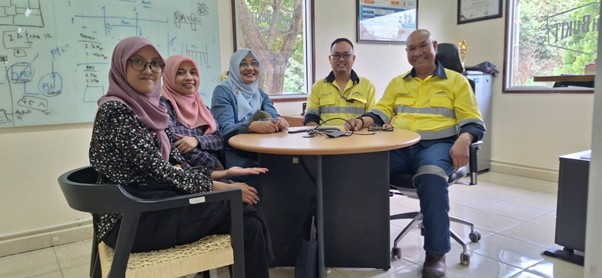
Efforts to support sustainable innovation in the environmental sector continue to grow. Lecturers from the Biology Study Program, FMIPA Universitas Negeri Yogyakarta (UNY), Prof. Dr. Tien Aminatun, S.Si., M.Si. and Dr. Anna Rakhmawati, S.Si., M.Si., have established a research collaboration with a mining industry partner, PT Bumi Suksesindo (PT BSI). The collaborative project is titled “Induction of Rhizobacteria and Compost Fertilizer in Phytomining of Low-Grade Ore in Gold Mining Areas Using Local Plants.” This research is conducted at the Tumpang Pitu gold mining site in Banyuwangi, East Java. Also known as the Tujuh Bukit Gold Mine, this site has been operated by PT BSI since 2017. The study is carried out in 2025 under the Fundamental Research–Regular funding scheme from the Ministry of Higher Education, Science, and Technology (Kemendikti Saintek).
The main objective of this research is to examine the effect of rhizobacteria induction and compost fertilizer on the ability of local plants to extract and accumulate gold from low-grade ore (spent ore) in situ. Spent ore refers to the residual rock from gold ore processing through heap leaching, where most of the valuable metals have already been extracted. However, this material often still contains trace amounts of gold that cannot be efficiently recovered using conventional heap leaching technology. Gold phytomining—defined as the extraction of gold from soil substrates by harvesting specially selected hyperaccumulator plants—offers a promising and environmentally friendly alternative for recovering residual gold from such low-grade materials. Therefore, this collaboration represents a concrete step toward strengthening synergy between academia and industry in developing biotechnology-based, eco-friendly solutions.
Accreditation
